Concrete and how it pollutes
FACT: China produces one third of the world’s concrete. In manufacturing 1.56 billion tones of concrete each year the equivalent amount of CO2 is released into the air. The current atmospheric concentration of CO2 is 390 ppm. CO2 makes up 85% of the total greenhouse gases globally.
FACT: Making one tonne of cement requires about two tones of limestone and shale. It consumes 4,000,000,000 joules of energy in electricity, process heat and transport. It produces approximately one tonne of CO2. It produces about 3 kg of NOX, an air contaminant that contributes to ground-level smog. It produces about .4 kg of PM10, an airborne particulate that is harmful to the respiratory tract when inhaled. The manufacturing of cement accounts for 5% of non-energy greenhouse gas emissions in Canada.
FACT: Annual production of concrete is five billion cubic yards, which is approximately a volume 17 football fields wide, 17 football fields long and 17 football fields tall—as tall as the tallest buildings in the world . Twice as much concrete is used in construction around the world than the total of all building materials, including wood, steel, plastic and aluminum. 600 million tones of fly ash (replacement for Portland cement) was produced in the world.
FACT: The health problems of concrete are: 1) Skin contact: getting cement dust or wet cement on your skin can cause burns, rashes and skin irritation. Sometimes workers get allergic over prolonged exposure to cement. 2) Eye contact: Getting concrete or cement dust in your eyes causes redness, irritation and possible chemical burns through long exposure. 3) Inhalation: Long term exposure to concrete dust containing crystalline silica can lead to a disabling lung disease called Silicosis.
SOLUTION: The design and use of concrete buildings has not brought humanity any closer to making safe, efficient structures. Most of the structures that have killed people in extreme disasters such as earthquakes, tsunamis, hurricanes, typhoons and tornadoes, have been concrete buildings. I would venture to say that it is with the advent of large, multi-level, concrete buildings that a great amount of human deaths have entered the realm of mass disaster.
We must find new structural systems that have tenuity: are able to withstand pull-apart forces as well as pushing forces and can distribute and dissipate a variety of forces throughout its form. We must devise a material that is lightweight, durable and strong—which concrete, for its weight, is not. Concrete is also very susceptible to water and becomes brittle in fire. We must also find shapes and forms that allow much more flexibility and distribution of stress and strain. These shapes are present in nature and have existed for billions of years yet we continue to ignore them.
The human effects of genetically modified foods
The Tremendous inefficiency of the automobile engine
FACT: 80% of the gas that we put into our car is expended on heat and friction. The remaining 20% moves a 4000 pound vehicle (average car weight) forward. If you weigh 150 pounds then you are 1/26th the weight of the car. So if you put, let’s say, $40.00 US into your car to fill the gas tank, then $32.00 US is transformed into heat and friction. The remaining $8.00 US is pushing the 4000 pound car forward. Since you are 1/26th of this weight then only 1/26th of $8.00 US is actually propelling you forward. This comes to $.30 US of your original $40.00 US that is genuinely moving your body forward. In other words, for every $40.00 US you put in your car, only 30 cents is moving you forward—a huge inefficiency. The rest of your $39.70 US has disappeared into heat, friction and the enertia of moving your 4000 pound vehicle. Is this how you want to spend your money?
SOLUTION: We must do away with the reliance on the internal combustion engine. It is perhaps the most inefficient machine in human history. And it is central to our polluting the environment throughout the world. We have been kept in complete ignorance about the laughable inefficiency of our vehicles. We only concern ourselves with the exterior appearances and no nothing about the substance and workings of the vehicle. We must develop new ideas that provide optimal efficiency and do not use fuels that are harmful to ourselves and the environment. We can direct ourselves to vehicles that use human power for propulsion. We need vehicles to transport ourselves and carry items that we create and those vehicles can be lightweight, strong and easy to manipulate—not the cumbersome, massively heavy, resource-robbing behemoths we drive today.
Natural disasters - we can survive them by designing as nature designs
Suffocating the planet with pavement and roads
Wednesday, September 8, 2010


Tuesday, September 7, 2010
Nature knows WHEN and WHERE - NOT to build and humans must learn this.
Nature knows WHEN and WHERE - NOT to build and humans must learn this.
When humans do build, do we look at if its appropriate to build there? Or is it pure economic veto that decides that we build something somewhere. Just because there are resources in a particular location in the world, does that mean we have to deplete it for what its worth?
Take these examples of built designs that are clogs in our natural arteries, in opposition to the natural context and just plain, shouldn't belong there.
The San Francisco Earthquake of 1906


Although we do not know when a earthquake is coming, our history is what we should learn from. Even though we know exactly where fault lines are and we've endured these huge earthquakes and sacrificed an abundance of lives during these incidents, we still continue to "fight" the natural consistency. Although several incidents similiar to the San Francisco earthquake has occured, we still ask, "how do we make these structures not fall down?" instead of asking ourselves, "Should we even build here?" or "Are these skyscrapers safe here?"
Chase Tower in Phoenix, Arizona - the largest skyscraper in Phoenix

Although Phoenix, Arizona has the hottest summer of all the cities in the US, we still continue to build higher and higher. Does heat not rise in Phoenix? It still does, but we still continue to build up. This leads to increased use of air conditioning, which uses a large amount of electricity.
Doesn't look like these belong here....


There are thousands of oil rigs sitting in just the Gulf of Mexico, mostly inactive. These sit here with no use, and even when it is used, they still shouldn't be there! Just look at the oil rig, then its surroundings.... Somethings not right.
New Orleans is 8 feet below sea level


The Big Easy is 8 feet below sea level. Something is wrong here. Why? I don't know. Possibly because New Orleans is a hot spot for resources - but shouldn't our primitive instincts or basic intellectual knowledge realize that building a city below sea level may have its consequences? Well in 2005, New Orleans felt that consequence, and most of the individuals that were the target of the levees breaking didn't know any better.
When humans do build, do we look at if its appropriate to build there? Or is it pure economic veto that decides that we build something somewhere. Just because there are resources in a particular location in the world, does that mean we have to deplete it for what its worth?
Take these examples of built designs that are clogs in our natural arteries, in opposition to the natural context and just plain, shouldn't belong there.
The San Francisco Earthquake of 1906


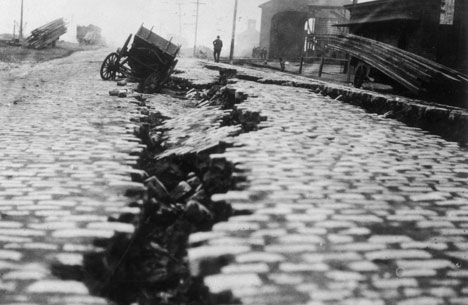
Although we do not know when a earthquake is coming, our history is what we should learn from. Even though we know exactly where fault lines are and we've endured these huge earthquakes and sacrificed an abundance of lives during these incidents, we still continue to "fight" the natural consistency. Although several incidents similiar to the San Francisco earthquake has occured, we still ask, "how do we make these structures not fall down?" instead of asking ourselves, "Should we even build here?" or "Are these skyscrapers safe here?"
Chase Tower in Phoenix, Arizona - the largest skyscraper in Phoenix

Although Phoenix, Arizona has the hottest summer of all the cities in the US, we still continue to build higher and higher. Does heat not rise in Phoenix? It still does, but we still continue to build up. This leads to increased use of air conditioning, which uses a large amount of electricity.
Doesn't look like these belong here....


There are thousands of oil rigs sitting in just the Gulf of Mexico, mostly inactive. These sit here with no use, and even when it is used, they still shouldn't be there! Just look at the oil rig, then its surroundings.... Somethings not right.
New Orleans is 8 feet below sea level


The Big Easy is 8 feet below sea level. Something is wrong here. Why? I don't know. Possibly because New Orleans is a hot spot for resources - but shouldn't our primitive instincts or basic intellectual knowledge realize that building a city below sea level may have its consequences? Well in 2005, New Orleans felt that consequence, and most of the individuals that were the target of the levees breaking didn't know any better.
Green Myths

http://hawaii-kau.com/catalog/products.php?Pakini_Nui_Wind_Farm
Myth 1: Wind Turbines Don't Impact The Earth


Myth 2: All Bottled Water Comes From Fresh Water Springs

Myth 3: The Entire Planet Is Warming Because Of CO2

Myth 4: Solar Power Is Economical


This one actually sounds plausible. Nikola Tesla claimed that free energy was indeed possible, and worked for most of his career to achieve it. The theory claims that he did, in fact, succeed, just before his death in 1943, in discovering the mathematics and mechanics involved, but that the FBI immediately broke into his home and seized all his papers and work, and has never released any of it to the public.
The concept of free energy is, in very general terms, the ability to input x amount of energy into a machine, which will output x + 1 amount of energy. This seems to conflict with the law of conservation of energy, which states that energy can neither be created nor destroyed. Tesla believed the law to be incorrect. He invented the Tesla Coil as an attempt to create free energy.
If it is possible, free energy could be perfected and result in the entire planet being powered by a single power source, such as a nuclear power plant, and output all the energy anyone could ever need. An infinite supply of energy at our fingertips, all based on electric output. You can see how this would irritate the oil companies.
They are the cause of the suppression, the theory claims, as no one would have to depend on fossil fuels anymore. Electric input is just as viable as coal input, or gasoline input. Thus, the electricity required to power a lightbulb could be all we need to power the whole world, invent spacecrafts capable of interstellar travel, anti-gravity, etc.
Myth 6: Plastic Bags Are Free
www.reuseit.com/.../plastic-bags-are-free

Myth 7: Organic Label Means 100% Organic
thedailygreen.com

Myth 8: LEED Certified Building

leedinthailand.com/tag/leed
Myth 9: Building Modular is Building Green
http://ezinearticles.com/?Prefabricated-Homes---The-Good,-The-Bad-And-The-Downright-Ugly&id=506163
Building modular is not a wise choice in building green. Buildings made from the mass production lose uniqueness and creativity. In other words, you are living in a house that looks exactly the same as your neighbor’s! Also these prefab buildings are not built specifically for the sites. Sometimes a wrong style of building would be built on an improper spot and end up using more energy in heating and cooling as required.
In addition, there seems to be very little evidence that prefabricated homes actually reduce wastage. Nobody could guarantee a building to be 100% perfect. In case when one of the popular modular designs has a problem, then lots of buildings with that particular design under mass production would need to get immediate repair and maintenance. This could actually increase the amount of wastage in manufacture and transport.
http://www.modulararchitecture.com/


http://www.infrastructurist.com/wp-content/uploads/800px-markham-suburbs_aerial-edit2.jpg

Myth 10: New Eco Water Bottle
“50% less plastic eco bottle!” This is just a beautiful lie from the bottled water industry. Plastic bottles can never be considered as “eco”. Exempt from many state deposit laws, and most often used away from home, where recycling bins are scarce, the majority of water bottles do not make it into the recycling stream. No matter how recyclable and eco-friendly the plastic bottles are, plastic is plastic and the plastic bottles we knock back always end up into landfills as result.
http://lighterfootstep.com/wp-content/uploads/2009/03/ecofina_600-590x393.jpg

http://www.almightydad.com/wp-content/uploads/2009/11/waterbottles1pa_468x324.jpg

Myth 11: Computers are highly recyclable and their e-wastes are free of PVC
---- Recycling program is not efficient enough. Some countries share one recycling provider, which requires long distance shipping. Disassembled laptops/notebooks and broken monitor are not accepted by the recycling programs. E- wastes end up in landfill.
---- Computers are not 100$ PVC free, PVC are still present in the external power cord and other add on components.
http://www.apple.com/environment/

http://www.greenpeace.org/australia/admin/image-library2/waste-china

http://www.scientificamerican.com/media/inline/blog/Image/computer-recycling-electronic-waste.jpg

Myth 12: Paper is better than plastic
http://www.reuseit.com/learn-more/myth-busting/why-paper-is-no-better-than-plastic
Paper bags are not better than plastic bags. It takes more than four times as much energy to manufacture a paper bag as it does to manufacture a plastic bag. During the manufacturing process, paper sacks generate 70% more air and 50 times more water pollutants than plastic bags. Although paper bags have a higher recycling rate than plastic, each new paper grocery bag you use is made from mostly virgin pulp for better strength and elasticity. Both virgin and recyclable paper come from tree pulp, so the impact of paper bag production on forests is enormous.
http://www.reuseit.com/learn-more/myth-busting/why-paper-is-no-better-than-plastic

http://www.durobag.com/Standard/Products.aspx?p=32&f=10

Monday, September 6, 2010
Navajo People
Daily Life
The Dine are people that pay great respect to their mother Earth. Their constant devotion to their religious beliefs and outlook on balance and healing is embedded onto their daily lives. Their rich culture of visual arts and music are well integrated with their mentality of being one with mother Earth. These principles and beliefs are well embedded into traditional Navajo daily life and culture. Everything is revolved around the foundation of their location, the Earth and their entire being.
Architecture
Navajo built structures are always of necessary functional use. They have the Hogan, which is their primary traditional home. Other structures include the summer shelter, underground home and the sweat house – all for either social function, bodily health, cooling or warming. The Hogan as described in the Navajo’s religion song “The Blessingway,” is being built by the coyote with help of the beavers for man, woman and the talking God. The Hogan resembles a pyramid with 5 triangular faces held up by structural framework logs. Earth filling is used in between the framework to create thick insulated walls for the winters. Within the Hogan, women cook, weave, talk and entertain while the men tell stories and jokes. If a death should occur in the Hogan, the body is either buried in the Hogan and the entry is sealed to warn others away, or the structure is abandoned and burned. Entry doors are always on the east face.
Clothing
Navajo clothing initially was made of deerskin for shirts and skirts, later on, men wore cotton or velvet shirts with no collars, breeches below the knee and moccasins. Women began to wear the squaw dress, made of plain dark blankets.
Diet
The main foods of the Navajo is mutton and corn. Flour is also consumed due to trading. Meats such as antelope, deer, elk, sheep and rabbits are considerable in Navajo diets. Other foods such as acorns, beans, potatoes, nuts, squash, pumpkin, berries, grapes and yucca fruit are eaten.
Education
The formal education that the Navajo children receive today is mostly within a general American curriculum. The Navajo Nation has a preparation school in New Mexico which is the only Navajo-sanctioned, college-prep school for Native Americans. In addition to the general American curriculum, there are topics taught to invoke youth appreciation for the Navajo language, culture and history. The Navajo also have a sanctioned two-year community college which its main campus is in Tsaile, Apache County, with seven other campuses on the reservation. Within the community college includes Dine (Navajo People) Studies, which elevates student’s learning through Nitsáhákees (thinking), Nahat'á (planning), Iiná (living), and Siihasin (assurance) in study of the Diné language, history, and culture in preparation for further studies and employment in a multi-cultural and technological world.
Beliefs
The traditional Navajo way contains no concept for religion, rather as a realm of activity separate from daily life. Navajo religion has been described as “life itself, the land, and well-being.” All living things - people, plants, animals, mountains, and the Earth itself - are relatives. Each being is infused with its own spirit, or “inner form,” which gives it life and purpose within an orderly and interconnected universe. The interrelatedness of all creation is recognized through daily prayer offerings and an elaborate system of ceremonies. The purpose of Navajo life is to maintain balance between the individual and the universe and to live in harmony with nature and the creator. In order to achieve this goal, Navajos must perform their religious practices on the specific, time honored areas in which they inhabit.
Houses & Traditional Structures


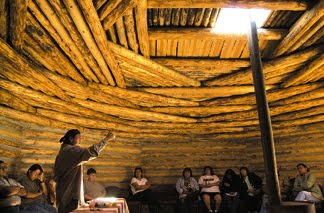
A hogan (pronounced /ˈhoʊɡɑːn/ or /ˈhoʊɡən/, from Navajo hooghan [hoːɣan]) is the primary traditional home of the Navajo people. Other traditional structures include the summer shelter, the underground home, and the sweat house. It is usually round and cone shaped, but now they make them square, with the door facing east to welcome the rising sun for good wealth and fortune.
The hogan is considered sacred to those who practice the Navajo religion. The religious song "The Blessingway" describes the first hogan as being built by Coyote with help from beavers to be a house for First Man, First Woman, and Talking God[1]. The Beaver People gave Coyote logs and instructions on how to build the first hogan, now known as a "forked stick" or "male" (áłchʼįʼ adeezʼá) hogan[1]; which resembles a pyramid with five triangular faces[1]. Earth may fill the spaces between the framework logs, hiding the five faceted shape and creating thick, winter-protective walls. The "forked stick" or "male" Hogan contains a vestibule in the front and was used only for sacred or private ceremonies[1].

The "circular" or "female" Hogan (tsé bee hooghan), the family home for the Diné people, is much larger and does not contain a vestibule. In it, the children play, the women cook, weave, talk, and entertain and men tell jokes and stories. Navajos made their hogans in this fashion until the 1900s, when they started to make them in hexagonal and octagonal shapes. The change in shape may have been due to the arrival of the railroad. A supply of wooden cross-ties, which could be laid horizontally to form walls of a larger, taller home, allowed the retention of the "female" hogan shape but with more interior room. The doorways of the hogans always face east[2].
Many cultural taboos are associated with the hogan and its use. Should a death occur in the structure, the body is either buried in the hogan with the entry sealed to warn others away, or the deceased is extracted through a hole knocked in the north side of the structure and it is abandoned and often burned. A hogan may also become taboo for further use if lightning strikes near the structure or a bear rubs against it. Wood from such structures is never reused for any other purpose by a Navajo[2].

Today, while some older hogans are still used as dwellings and others are maintained for ceremonial purposes, new hogans are rarely intended as family dwellings.
Clothing


Navajo clothing for both men and women initially was deerskin for shirts and skirts. The men later wore cotton or velvet shirts with no collars, breeches below the knee, and moccasins. Women gradually wore the "squaw dress," made of plain dark blankets
Dress
Primitively the men dressed in deerskin shirts, hip-leggings, moccasins, and native blankets. These were superseded by what has been the more universal costume during the present generation: close-fitting cotton or velvet shirt, without collar, cut rather low about the neck and left open under the arms; breeches fashioned from any pleasing, but usually very thin, material, and extending below the knees, being left open at the outer sides from the bottom to a little above the knees; deerskin moccasins with rawhide soles, which come to a little above the ankles, and brown deerskin leggings from moccasin-top to knee, held in place at the knee by a woven garter wound several times around the leg and the end tucked in.
Diet


Find out what are some traditional Navajo foods still eaten today? What are some traditional Navajo foods from the past, but not commonly eaten today? What are the various foods prepared from a sheep? What are foods made with corn?
The principal food is mutton, boiled, and corn prepared in many ways. Considerable flour obtained from traders is consumed; this is leavened slightly and made into small cakes, which are cooked over the embers like Mexican tortillas.
The four days preceding the night of the ceremony are days of abstinence; only such foods as mush and bread made from corn-meal may be eaten, nor may they contain any salt. To indulge in viands of a richer nature would be to invite laziness and an ugly form at a comparatively early age. The girl must also refrain from scratching her head or body, for marks made by her nails during this period would surely become ill-looking scars. All the women folk in the hogán begin grinding corn on the first day and continue at irregular intervals until the night of the third, when the meal is mixed into batter for a large corn-cake, which the mother bakes in a sort of bean-hole outside the hogán.
Foods (Primitive)
English Apache Jicarilla Navaho
acorns chĭd-jí̆l na-tó-ka-tsĕ ché̆-chĭl bi-ná
antelope já-gĕ ta-gá-tĕ jú̆-dĭ
beans (native) bé̆s-tsoz ná-o-hlĕ-tsos-tĕt nú̆-o-hlĭ
cedar berries dĭl-tú-hla du-tlí̆sh-ĭ kal-tú-stĕ-ih dit-zé̆
corn na-tán na-tán na-tán
deer bin bi^{n) bin
elk bin nal-dé̆ tzĕs tzĕ
grapes (wild) dŭh-tsá tŭt-zé̆ tŭt-zé̆
juniper berries dĭl-tú-hla chĭl-há-zhĕ
mescal (agave) ná-ta ná-ta ná-ta
mountain sheep dĕ-bé̆-chụ zi-dĕ-bé̆ tsĕ-tú̆-dĕ-bĕ
piñon nuts o-bé̆ nĕs-chí nĕs-chí
potatoes (wild) ĭlh-tsú si-tsí̆n-nĭ pi-ji-né̆ ná-ma-si
prairie-dogs ăn klun klun
pumpkins bĕlh-kún na-yí-zĕ na-yĭ-zĭ-chí
rabbits (jack) gah-chú gah-tsó gah-tsó
rabbits (cottontail) gah-chi-lé̆ gah-chĭ-shé̆ gah
rats (wood) klosh-chú klé̆-tso klĕ-é̆-tso
squash gó-chi bĕlh-kún na-yí-zĕ na-yí̆-zĭ
yucca fruit gu-skú̆n kash-kán kŭsh-kán


The Dine are people that pay great respect to their mother Earth. Their constant devotion to their religious beliefs and outlook on balance and healing is embedded onto their daily lives. Their rich culture of visual arts and music are well integrated with their mentality of being one with mother Earth.
Navajo Culture - The Navajo are people very geared toward family life and events that surround their lifestyle. Many games and traditions have emerged from their love of the land and their attachment to it. Long winter nights and the seclusion of the reservation has brought about most of the customs and activities used by the People to entertain and amuse themselves.
Ceremonies
The Navaho life is particularly rich in ceremony and ritual, second only to some of the Pueblo groups. Note is made of nine of their great nine-day ceremonies for the treatment of ills, mental and physical. There are also many less important ceremonies occupying four days, two days, and one day in their performance. In these ceremonies many dry-paintings, or "sand altars," are made, depicting the characters and incidents of myths. Almost every act of their life—the building of the hogán, the planting of crops, etc.—is ceremonial in nature, each being attended with songs and prayers.
The Navaho life is particularly rich in ceremony and ritual, second only to some of the Pueblo groups. Note is made of nine of their great nine-day ceremonies for the treatment of ills, mental and physical. There are also many less important ceremonies occupying four days, two days, and one day in their performance. In these ceremonies many dry-paintings, or "sand altars," are made, depicting the characters and incidents of myths. Almost every act of their life—the building of the hogán, the planting of crops, etc.—is ceremonial in nature, each being attended with songs and prayers.
The formal education that the Dine receive today is mostly within the grasp of common American educational systems. Although Dine do have a Navajo Preparatory School in New Mexico which is the only Navajo-sanctioned, college-preparatory school for Native Americans. Its goals are to offer students a challenging, innovative curriculum in science, math, computers, and other traditional academic subjects, as well as help the youth gain a deep appreciation of the Navajo Language, culture, and history.[3]
Located in Farmington, New Mexico, a few miles outside the Navajo reservation, Navajo Preparatory School's mission is: "To educate talented and motivated college-bound Navajo and other Native American youth who have the potential to succeed in higher education and become leaders in their respective communities."
They also have a Dine College, a two-year community college which has its main campus in Tsaile in Apache County, as well as seven other campuses on the reservation. Current enrollment is 1,830 students, of which 210 are degree-seeking transfer students for four-year institutions. The college includes the Center for Diné Studies, whose goal is to apply Navajo Sa'ah Naagháí Bik'eh Hózhóón principles to advance quality student learning through Nitsáhákees (thinking), Nahat'á (planning), Iiná (living), and Siihasin (assurance) in study of the Diné language, history, and culture in preparation for further studies and employment in a multi-cultural and technological world.Religion
The traditional Navajo way contains no concept for religion as a sphere of activity separate from daily life. Navajo religion has been described as 'life itself, the land, and well-being.' All living things - people, plants, animals, mountains, and the Earth itself - are relatives. Each being is infused with its own spirit, or 'inner form', which gives it life and purpose within an orderly and interconnected universe. The interrelatedness of all creation is recognised through daily prayer offerings and an elaborate system of ceremonies. The purpose of Navajo life is to maintain balance between the individual and the universe and to live in harmony with nature and the Creator. In order to achieve this goal, Navajos must perform their religious practices on the specific, time honoured areas which they inhabit.
Notes & References
Houses, Clothing, Diet, Daily Life, Education, Religion
Children of fathers God
One with Nature
Taboo with Death
Navajo aren't suppose to bother the dead
get rid of their bothering, get rid of their house, don't have photos of them
We were free people, things are changing
Hunger, poverty, given alcohol
Gas, paint sniffing, vapor abuse, all the cans have holes, mouthwash drink, hairspray, gas, antifreeze
All these people are intelligent, caring, try hard.
Why do they have a destructive behavior?
The 2' law, no water
Navajo People:
300,000 Strong
Alot of medicine people
Alot of the ways
Dineh
Largest in the US
14 Million Acre of reservation land
Operates in Window Rock, Arizona
Seek of balance between Culture and Commerce, in a way of preserving lifestyle
They would like to be independent from the US Government
http://www.youtube.com/watch?v=ustcINCDffA
Navajo Culture and Life
4 Cycles, 4 Elements, 4 Seasons
Summer Fire
Spring - Earth
Winter - Water
Fall - Air
4 Stages of Life - Childhood, Youth, Adult and Old Age
As a Person - Physical, Emotional, Mental, Spiritual
Male and Female are not opposites
All part of one, were all in this boat together.
They count age by how many winters they have endured
http://www.youtube.com/watch?v=LeM0l9P9oc4&NR=1
http://navajopeople.org
http://www.xpressweb.com/zionpark/index3.html
http://www.navajoprep.com/about-us.html
http://en.wikipedia.org/wiki/Navajo_Preparatory_School
Subscribe to:
Posts (Atom)