Concrete and how it pollutes
FACT: China produces one third of the world’s concrete. In manufacturing 1.56 billion tones of concrete each year the equivalent amount of CO2 is released into the air. The current atmospheric concentration of CO2 is 390 ppm. CO2 makes up 85% of the total greenhouse gases globally.
FACT: Making one tonne of cement requires about two tones of limestone and shale. It consumes 4,000,000,000 joules of energy in electricity, process heat and transport. It produces approximately one tonne of CO2. It produces about 3 kg of NOX, an air contaminant that contributes to ground-level smog. It produces about .4 kg of PM10, an airborne particulate that is harmful to the respiratory tract when inhaled. The manufacturing of cement accounts for 5% of non-energy greenhouse gas emissions in Canada.
FACT: Annual production of concrete is five billion cubic yards, which is approximately a volume 17 football fields wide, 17 football fields long and 17 football fields tall—as tall as the tallest buildings in the world . Twice as much concrete is used in construction around the world than the total of all building materials, including wood, steel, plastic and aluminum. 600 million tones of fly ash (replacement for Portland cement) was produced in the world.
FACT: The health problems of concrete are: 1) Skin contact: getting cement dust or wet cement on your skin can cause burns, rashes and skin irritation. Sometimes workers get allergic over prolonged exposure to cement. 2) Eye contact: Getting concrete or cement dust in your eyes causes redness, irritation and possible chemical burns through long exposure. 3) Inhalation: Long term exposure to concrete dust containing crystalline silica can lead to a disabling lung disease called Silicosis.
SOLUTION: The design and use of concrete buildings has not brought humanity any closer to making safe, efficient structures. Most of the structures that have killed people in extreme disasters such as earthquakes, tsunamis, hurricanes, typhoons and tornadoes, have been concrete buildings. I would venture to say that it is with the advent of large, multi-level, concrete buildings that a great amount of human deaths have entered the realm of mass disaster.
We must find new structural systems that have tenuity: are able to withstand pull-apart forces as well as pushing forces and can distribute and dissipate a variety of forces throughout its form. We must devise a material that is lightweight, durable and strong—which concrete, for its weight, is not. Concrete is also very susceptible to water and becomes brittle in fire. We must also find shapes and forms that allow much more flexibility and distribution of stress and strain. These shapes are present in nature and have existed for billions of years yet we continue to ignore them.
The human effects of genetically modified foods
The Tremendous inefficiency of the automobile engine
FACT: 80% of the gas that we put into our car is expended on heat and friction. The remaining 20% moves a 4000 pound vehicle (average car weight) forward. If you weigh 150 pounds then you are 1/26th the weight of the car. So if you put, let’s say, $40.00 US into your car to fill the gas tank, then $32.00 US is transformed into heat and friction. The remaining $8.00 US is pushing the 4000 pound car forward. Since you are 1/26th of this weight then only 1/26th of $8.00 US is actually propelling you forward. This comes to $.30 US of your original $40.00 US that is genuinely moving your body forward. In other words, for every $40.00 US you put in your car, only 30 cents is moving you forward—a huge inefficiency. The rest of your $39.70 US has disappeared into heat, friction and the enertia of moving your 4000 pound vehicle. Is this how you want to spend your money?
SOLUTION: We must do away with the reliance on the internal combustion engine. It is perhaps the most inefficient machine in human history. And it is central to our polluting the environment throughout the world. We have been kept in complete ignorance about the laughable inefficiency of our vehicles. We only concern ourselves with the exterior appearances and no nothing about the substance and workings of the vehicle. We must develop new ideas that provide optimal efficiency and do not use fuels that are harmful to ourselves and the environment. We can direct ourselves to vehicles that use human power for propulsion. We need vehicles to transport ourselves and carry items that we create and those vehicles can be lightweight, strong and easy to manipulate—not the cumbersome, massively heavy, resource-robbing behemoths we drive today.
Natural disasters - we can survive them by designing as nature designs
Suffocating the planet with pavement and roads
Showing posts with label WHAT IS HUMANITY DOING TO NATURE. Show all posts
Showing posts with label WHAT IS HUMANITY DOING TO NATURE. Show all posts
Wednesday, September 8, 2010
Friday, September 3, 2010
VI) Destruction of the Natural Environment
Melting ice caps


Drying rivers and lakes

Desertification


Deforestation


seos-project.eu
argentinaindependent.com
photos.wildmadagascar.org
blog.lib.umn.edu
thedailygreen.com
OUR FORESTS ARE DISAPPEARING
FACT: The world’s ancient forests are being cut down at a surprising rate. The area of forest the size of a soccer field is cut down every two seconds. When we lose a forest we lose biodiversity. The current rate of extinction of plant and animal species is 1000 times faster than pre-human times. This will accelerate to 10,000 faster by 2050. Damage to ancient forests is not only a matter of deforestation. It also concerns the fact that it can no longer sustain plants and animals. In the tropics alone over 5 million square kilometers have been logged and over 3.5 million square kilometers have been totally deforested. Rainforests are being cut down at a rate of 100 US acres per minute.
FACT: In the USA, to produce the Sunday newspaper, 500,000 trees are cut down. Recycling a single run of the New York Times would save 75,000 trees. In one year, the average American throws away 1 billion trees worth of paper. It would be enough paper to heat 50,000,000 homes for 20 years. The construction cost of a paper mill designed to use waste paper is 50% TO 80% less than the cost of a mill using new paper pulp. The average USA household throws away 13,000 separate pieces of paper each year—most is packaging and junk mail.
FACT: Less than 10% of the world’s forests still remain. 82 countries out of 148 lying within the original forest zone have lost their intact forests. 49% of the remaining intact forests are the tropical forests of Latin America, Africa and Asia Pacific. 44% of the remaining intact forests are the boreal forests of Russia, Canada and Alaska. Rainforests of Southeast Asia are home to thousands of incredible species of flowers, as big as sofas, the world’s largest butterflies, pygmy elephants, flying snakes, orange Orangutans and other fantastic animals and life forms. This life is being killed because of the consumer society’s demand for rare wood. Timber is being logged off to create furniture for the wealthy, huge areas are cleared to grow soy beans, coffee, cattle and palm oil. At current rates Orangutans will be extinct within 10 years. The forests will be gone by 2050.
FACT: It is estimated that the burning and cutting done of the Southeast Asia forests contribute 20% to the world’s greenhouse gas emissions. The rainforest destruction releases so much CO2 that it is the third largest emitter of CO2 in the world! The CO2 is caused by the drying, draining and burning of these forests. Major multinational businesses profit from these activities and the large international banks and monetary funds of the world support it. Financial profit has replaced the protection of life. The World Bank and the International Finance Corporation has been financing rainforest destruction for profit financing Palm Oil plantations with $200 million US grants.
FACT: Palm oil is used for everything including ice cream, cosmetics and margarine. Palm tree plantations are now the leading cause of rainforest destruction in Southeast Asia. Financing for Palm Oil comes from The Asian Development Bank, British and Swiss banks, and multinational corporations such as Nestle, Unilever, Proctor and Gamble and rich Indonesian companies that profit from Palm oil. Countries are competing to out produce one another and this competition fuels the destruction of the forests and the tremendous increase in CO2.
The destruction of rainforests, the annihilation of precious forest life and the massive release of carbon dioxide that results, call attention to the tremendous environmental emergency we all face. We are blinded by the maniacal obsession with profit and acquisition and must be reminded that without our home, our earth, everything else we do has no meaning.
Air Polution

Air Traffic Maps


International Shipping Routes

Noise Pollution


Worlds Largest Ship


.jpg)

TRANSATLANTIC FLIGHTS AND SHIP TRAVEL
FLYING
FACT: Large airports of the world pump 1.3 million gallons of gas per day. 494 planes fly every day. A commercial plane burns 4 liters of gas every second. Over the course of a 10 hour flight a commercial plane burns about 36,000 gallons of gas. A flight from London, England to Miami, Florida, USA (14,207 kilometers) produces 2415 kg of CO2 per passenger –more than the 2,255 kg of CO2 produced annually by the average British motorist. The industry has cut emissions from engines by 50% but the growth in the number of planes and travelers vastly outweighs any such improvement in gas emissions.
FACT: Air travel is the fastest growing mode of transportation in the world growing 100 fold in the last 50 years and is expected to grow another 10 times by 2050. The Institute of Public Policy Research has stated, “Flying by jet plane is the least environmentally sustainable way to travel and transport goods.” Aircraft pump out carbon dioxide and other greenhouse gases high in the atmosphere, where they do the most damage. The Intergovernmental Panel on Climate Change calculates that aircraft flight contributes the same amount of greenhouse gases as the entire country of Canada; about 4% globally. By 2050 this will increase possibly to 17% or more.
FACT: Studies confirm that airports are the biggest polluters of whatever city they may be in. New York’s JFK Airport is the biggest nitrogen oxide polluter in New York. Frankfurt’s airport produces 75% of the City of Frankfurt’s emissions of unburnt hydrocarbons and 50% of its load of carbon monoxide, sulfur and nitrogen dioxide. A US government study found that pollution from aviation has increased cancer rates around Chicago-Midway airport.
FACT: Noise pollution is another not-talked about issue that affects human health. Excessive noise damages health ranging from hearing damage to heart disease. Studies around Munich airport and New York’s La Guardia and JFK airports conclude that it impairs memory and reading ability. Studies show that air travel has little benefit on aircraft companies. They are subsidized by governments which support air travel and this, in turn, supports the increasing expansion of air travel.
FACT: Over time, as many gas pollutants are released in the air, carbon dioxide stays twice as long in the air because it stays at high elevations—which captures heat for decades—and keeps heat on the surface of the planet. Air travel destroys good ozone and creates bad ozone. In the stratosphere where many supersonic and military jets fly, pollution from the jets destroys the ozone layer. Ozone in the atmosphere is a good thing because it shields the earth from harmful ultraviolet radiation.
FACT: Military aircraft use more fuel per plane than commercial airplanes. Military aircraft are 25% less numerous than commercial jets but consume one third total fuel use. They also produce more toxic gases in the air. Aircraft release huge plumes of exhaust during taxiing, idling, take-offs and landings. One airplane take-off and landing from JFK airport in the 1990’s would produce as much nitrogen oxide as a car driven 26,500 miles. Many airports are among the top ten polluters of their cities.
SHIPS
FACT: One giant container ship can emit the same amount of cancer and asthma-producing chemicals as 50 million cars. Governments around the world have been neglecting or underestimating the harmful effects of shipping. Confidential data based in engine size and quality of fuel typically used by ships (Low grade ship bunker fuel or fuel oil) show that just 15 of the world’s biggest ships now emit as much pollution as ALL of the world’s cars—760 million cars. Low grade ship bunker oil has up to 2000 times the sulphur content of diesel fuel used in US and European cars.
FACT: Pollution from the world’s 90,000 cargo ships leads to 60,000 deaths a year in the US alone and costs up to $330 billion per year in health costs from lung and heart disease. A new study by the Danish Environmental Agency reveals that shipping emissions cost the industry 5 billion EU a year in health costs, mainly treating cancer and heart problems. 1000 Danish people die each year from shipping pollution.
FACT: Shipping in China has escalated in the past 15 years. The Chinese container ships are cost efficient but the fuel quality is of the lowest kind. Ship pollution affects the health of communities around the world. The calculations of ship and car pollution are based on the world’s largest 85, 790 kw ship’s diesel engines which operate 280 days a year generating 5,200 tonnes of sulphur dioxide a year.
FACT: The world’s biggest ships container ships have 109,000 horsepower engines which weigh 2,300 tons. Each ship expects to operate 24 hours a day, 280 days a year. There are 90,000 ocean-going cargo ships in the world. Shipping is responsible for up to 30% of the world’s nitrogen oxide pollution and 9% of the world’s sulphur oxide pollution. One large ship can generate 5,000 tonnes of sulphur oxide pollution in a year. 70% of all ships emissions are within 400km of land. 85% of all ship pollution is in the northern hemisphere. Shipping is responsible for up to 4% of all climate change emissions.
V) Abundance of Humane Waste
Where do our Car Tires go?


WHERE DO OUR CAR TIRES GO?
FACT: Tires are not biodegradable. Tires need to be retreaded and repurposed rather than discarded. Oceans of tires exist in dump sites around the world. The world’s largest tire dump is located in Hudson, Colorado in the USA. It has over 30 million tires waiting for recycling and processing. In the USA , every year 300 million tires are disposed of. In the USA there are an estimated 5000+ tire dump sites each with 10 to 25 million throw-out tires. Burning tires produces nearly the same amount of poisonous carbon as burning coal. 40 million tires are discarded every year in the United Kingdom. Then annual consumption rate of China and India is growing. They are the most populated countries in the world. By 2020 there is anticipated to be a deficit in the world’s rubber supply. Worldwide, at least 1,000,000,000 tires are discarded annually. The main countries participating in this is the USA, Western Europe and the Far East. In the USA, 50% are taken to landfill sites and dumped, 40% are incinerated and 10% are recycled.
FACT: Tires are made up of natural and synthetic rubber and petroleum products containing 17 types of heavy metals including bromium, lead, benzene and mercury and other organic compounds. Such metals are not only carcinogens but also lead to many health hazards like poisoning. When tires are burned their metals are released to the atmosphere and can easily enter the human body. The process of burning produces harmful gases like benzene, styrene and 1,2,3 butadine. The gases can enter our bodies as very small particulate matter that enters our circulatory system. Cancer and lead poisoning are common sicknesses. Gaseous pollutants like dioxins are formed and released during burning and is a very potent carcinogen. Dioxin is one of the most harmful gases in the world and very harmful to public health. When tires come in contact with rainwater it pollutes the water. The heavy metals in the water never disappear and is hazardous to plants and animals as well.
SOLUTION: Over 10 million used tires were ground up and used in the USA for rubberized asphalt for highways lowering the cost of highway construction. Tires are often used as recycled materials for use on basketball courts, shoes, playgrounds, back fill, garden mulch, erosion control barriers or drainage foundations around buildings. Germany, Austria, Belgium, Denmark, Finland, France, Germany, Hungary, the Netherlands, Portugal, Slovakia, Sweden and Norway all claimed 100% diversion of tires from landfills. The United Kingdom leads the way for recycled tires.
The Pacific Gyre


challengerdeep.org
mistersustainable.com
THE PACIFIC GYRE AND OTHER OCEAN GYRES: The World’s Plastic Garbage in the Sea
FACT: Why can’t we see a floating island of plastic garbage ¼ the size of China? Because the floating particles are very small and float to a depth of 100 meters below the surface. From the air and the water’s surface you can barely see anything. The plastic is so small that is requires high-intensity trawling—similar to that for catching shrimp. And shrimp trawling kills 10 kilograms of non-targeted life, i.e., sharks, turtles, dolphins, fish, etc., for every 1 kilogram of shrimp. Plastic kills more ocean life because it is eaten by sea life and kills it. It is estimated that over 100,000 marine animals and sea turtles and over one million sea birds are killed by the floating trash pile each year. Sometimes called, “The Asian Trash Trail”, or, “The Eastern Garbage Patch”, its contents stem largely from the Pacific Rim countries and travel eastward into the calm currents of the Pacific Ocean.
FACT: 10 million tons of plastic produced each year ends up in the sea. 20 per cent of it is from the ships and oil platforms and the rest is from the land. The swirls of trash are choked with dead fish, marine mammals and birds that are snared or have died from ingesting the plastic. Some plastic will not break down for centuries, others will never break down. The floating plastic material absorbs waterborne toxic chemicals like DDT and PBC and is eaten by marine animals that are then eaten by humans. The Pacific Gyre is 1,700 miles (…..kilometers) in diameter—which is about one-third the size of China.
FACT: The plastic acts as a chemical sponge of highly toxic pollutants which are ingested by marine animals and birds and transferred down the food chain. The Pacific Gyre is only one of five major gyres in the world. The Sargasso Sea of the Atlantic ocean is another area where giant amounts of plastic particles are accumulating. Tiny plastic pieces now outweigh zooplankton by 10 to 1. The plastic is digested and sent down the food chain. 80% of the plastic; bottles, bags, etc., are thrown into sewers, streams, rivers, which eventually travel to our oceans.
FACT: Ocean organisms grow on the floating plastic and be transported to areas far beyo0nd their normal habitat. These ocean colonies can then infiltrate new habitats and cause destruction. 70% of the plastic sinks to the ocean bottom. In the North Sea, scientists have counted 600,000 tonnes of plastic which can smother the sea bottom and kill marine life found there. A recent research vessel counted 13,000 pieces of plastic for every square kilometer of ocean and estimate that 8 million pieces of litter enter the oceans very day!
FACT: Marine researchers have found an abundance of plastic garbage pollution in every sample of ocean water taken on the first transatlantic of its kind. A collaboration of research foundations have created the 5 Gyres Project and have found plastic fragments of toothbrushes, bottle caps, cigarette lighters, golf balls, dolls and many other items, on their 3000 mile voyage through the Sargasso Sea in the North Atlantic Ocean that has never been examined. Their research has confirmed that a similar scenario is revealed; a thousand miles of floating trash discarded from the east coast areas of North America, and Western Europe and Africa. This is not a national phenomenon. It is a global problem of human behavior.
It has been confirmed now by researchers around the world; the oceans of the world are floating landfills of garbage, and the garbage is being reduced to smaller and smaller bits so that ocean life digests the plastic which is eventually eaten by humans. In this regard, the ocean garbage is more virulent than landfill, it is being eaten and absorbed by sea life that we eat, and affects every person and future generations of people.
The crux of the matter is our behavior. We buy and throw away materials, particularly plastic materials, without thinking. We don’t consider that all the plastic packages, bags, gloves, toothbrushes, boxes, mobile phones, computers, televisions and even automobiles, do not biologically deteriorate. The pieces get smaller but do not disappear. They creep into our soil, into our water, and into the fish and mammals that we eat. We are slowly poisoned by our own garbage. The earth is being poisoned by our attitudes and behaviors. We are solely responsible for this and only we can stop it. There is only one solution. We must examine our attitudes and behaviors and change; or we will perish from our own arrogance and indolence.
FACT: Why can’t we see a floating island of plastic garbage ¼ the size of China? Because the floating particles are very small and float to a depth of 100 meters below the surface. From the air and the water’s surface you can barely see anything. The plastic is so small that is requires high-intensity trawling—similar to that for catching shrimp. And shrimp trawling kills 10 kilograms of non-targeted life, i.e., sharks, turtles, dolphins, fish, etc., for every 1 kilogram of shrimp. Plastic kills more ocean life because it is eaten by sea life and kills it. It is estimated that over 100,000 marine animals and sea turtles and over one million sea birds are killed by the floating trash pile each year. Sometimes called, “The Asian Trash Trail”, or, “The Eastern Garbage Patch”, its contents stem largely from the Pacific Rim countries and travel eastward into the calm currents of the Pacific Ocean.
FACT: 10 million tons of plastic produced each year ends up in the sea. 20 per cent of it is from the ships and oil platforms and the rest is from the land. The swirls of trash are choked with dead fish, marine mammals and birds that are snared or have died from ingesting the plastic. Some plastic will not break down for centuries, others will never break down. The floating plastic material absorbs waterborne toxic chemicals like DDT and PBC and is eaten by marine animals that are then eaten by humans. The Pacific Gyre is 1,700 miles (…..kilometers) in diameter—which is about one-third the size of China.
FACT: The plastic acts as a chemical sponge of highly toxic pollutants which are ingested by marine animals and birds and transferred down the food chain. The Pacific Gyre is only one of five major gyres in the world. The Sargasso Sea of the Atlantic ocean is another area where giant amounts of plastic particles are accumulating. Tiny plastic pieces now outweigh zooplankton by 10 to 1. The plastic is digested and sent down the food chain. 80% of the plastic; bottles, bags, etc., are thrown into sewers, streams, rivers, which eventually travel to our oceans.
FACT: Ocean organisms grow on the floating plastic and be transported to areas far beyo0nd their normal habitat. These ocean colonies can then infiltrate new habitats and cause destruction. 70% of the plastic sinks to the ocean bottom. In the North Sea, scientists have counted 600,000 tonnes of plastic which can smother the sea bottom and kill marine life found there. A recent research vessel counted 13,000 pieces of plastic for every square kilometer of ocean and estimate that 8 million pieces of litter enter the oceans very day!
FACT: Marine researchers have found an abundance of plastic garbage pollution in every sample of ocean water taken on the first transatlantic of its kind. A collaboration of research foundations have created the 5 Gyres Project and have found plastic fragments of toothbrushes, bottle caps, cigarette lighters, golf balls, dolls and many other items, on their 3000 mile voyage through the Sargasso Sea in the North Atlantic Ocean that has never been examined. Their research has confirmed that a similar scenario is revealed; a thousand miles of floating trash discarded from the east coast areas of North America, and Western Europe and Africa. This is not a national phenomenon. It is a global problem of human behavior.
It has been confirmed now by researchers around the world; the oceans of the world are floating landfills of garbage, and the garbage is being reduced to smaller and smaller bits so that ocean life digests the plastic which is eventually eaten by humans. In this regard, the ocean garbage is more virulent than landfill, it is being eaten and absorbed by sea life that we eat, and affects every person and future generations of people.
The crux of the matter is our behavior. We buy and throw away materials, particularly plastic materials, without thinking. We don’t consider that all the plastic packages, bags, gloves, toothbrushes, boxes, mobile phones, computers, televisions and even automobiles, do not biologically deteriorate. The pieces get smaller but do not disappear. They creep into our soil, into our water, and into the fish and mammals that we eat. We are slowly poisoned by our own garbage. The earth is being poisoned by our attitudes and behaviors. We are solely responsible for this and only we can stop it. There is only one solution. We must examine our attitudes and behaviors and change; or we will perish from our own arrogance and indolence.
Rivers and lakes becoming dying swamps of trash


Plastics what does it do to us?


PLASTICS: WHAT DOES IT DO TO US?
FACT: Styrene, the material that many lunch packages in China is made of, and used around the world as packaging material, is toxic to the brain and nervous system; among workers with long-term exposure, it has been found to adversely affect red blood cells, liver, kidney and stomach in animal studies. In addition to exposure to food containers, children can be exposed to styrene through second-hand cigarette smoke, off-gassing of building materials, auto exhaust fumes and drinking water.
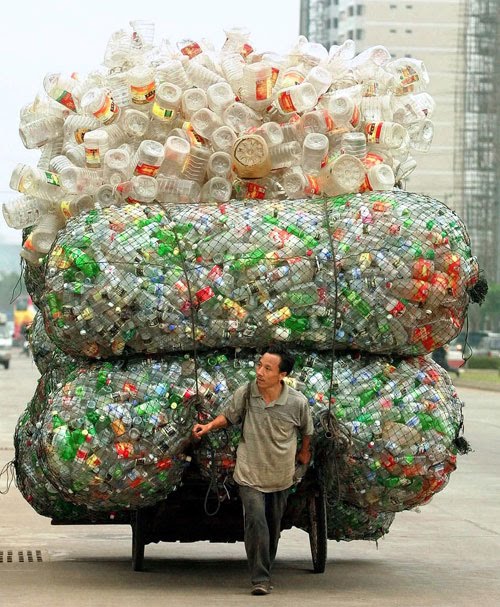
FACT: Plastics are everywhere; the air, our bodies, water, the oceans and so on. Plastics are toxic, both base plastics and additives. Almost everything we touch is made of or coated with plastics. We are all exposed every minute of every day. Almost nothing is known about individual chemicals that make up plastics. Nothing is known about the effects of combinations of plastics and other things including ionization of radiation (microwaves). In the USA, 2,500,000 plastic bottles are thrown away every hour. Plastic bags and garbage thrown into the ocean kill 1,000,000 sea creatures every year. Recycling plastic saves twice as much energy as incinerating it. Americans throw away 25,000,000,000 styrofoam coffee cups every year.
Plastic Common Uses Adverse Health Effects
Polyvinyl
chloride
(#3PVC) Food packaging, plastic wrap, containers for toiletries, cosmetics, crib bumpers, floor tiles, pacifiers, shower curtains, toys, water pipes, garden hoses, auto upholstery, inflatable swimming pools Can cause cancer, birth defects, genetic changes, chronic bronchitis, ulcers, skin diseases, deafness, vision failure, indigestion, and liver dysfunction
Phthalates
(DEHP,
DINP,
and others) Softened vinyl products manufactured with phthalates include vinyl clothing, emulsion paint, footwear, printing inks, non-mouthing toys and children’s products, product packaging and food wrap, vinyl flooring, blood bags and tubing, IV containers and components, surgical gloves, breathing tubes, general purpose labware, inhalation masks, many other medical devices Endocrine disruption, linked to asthma, developmental and reporoductive effects. Medical waste with PVC and pthalates is regularly incinerated causing public health effects from the relese of dioxins and mercury, including cancer, birth defects, hormonal changes, declining sperm counts, infertility, endometriosis, and immune system impairment.
Polycarbonate, with Bisphenol A (#7) Water bottles Scientists have linked very low doses of bisphenol A exposure to cancers, impaired immune function, early onset of puberty, obesity, diabetes, and hyperactivity, among other problems (Environment California)
Polystyrene Many food containers for meats, fish, cheeses, yogurt, foam and clear clamshell containers, foam and rigid plates, clear bakery containers, packaging "peanuts", foam packaging, audio cassette housings, CD cases, disposable cutlery, building insulation, flotation devices, ice buckets, wall tile, paints, serving trays, throw-away hot drink cups, toys Can irritate eyes, nose and throat and can cause dizziness and unconsciousness. Migrates into food and stores in body fat. Elevated rates of lymphatic and hematopoietic cancers for workers.
Polyethelyne
(#1 PET) Water and soda bottles, carpet fiber, chewing gum, coffee stirrers, drinking glasses, food containers and wrappers, heat-sealed plastic packaging, kitchenware, plastic bags, squeeze bottles, toys Suspected human carcinogen
Polyester Bedding, clothing, disposable diapers, food packaging, tampons, upholstery Can cause eye and respiratory-tract irritation and acute skin rashes
Urea-
formaldehyde Particle board, plywood, building insulation, fabric finishes Formaldehyde is a suspected carcinogen and has been shown to cause birth defects and genetic changes. Inhaling formaldehyde can cause cough, swelling of the throat, watery eyes, breathing problems, headaches, rashes, tiredness
Polyurethane
Foam Cushions, mattresses, pillows Bronchitis, coughing, skin and eye problems. Can release toluene diisocyanate which can produce severe lung problems
Acrylic Clothing, blankets, carpets made from acrylic fibers, adhesives, contact lenses, dentures, floor waxes, food preparation equipment, disposable diapers, sanitary napkins, paints Can cause breathing difficulties, vomiting, diarrhea, nausea, weakness, headache and fatigue
Tetrafluoro-
ethelyne Non-stick coating on cookware, clothes irons, ironing board covers, plumbing and tools Can irritate eyes, nose and throat and can cause breathing difficulties
It is known that plastics migrates into food and, I suspect, everything else that it touches. Already scientists are seeing that plastic water bottles are affecting the water contained within. As consumers we tend to look for the status quo to maintain our lives. We buy without thought to whether what we are buying is at all harmful. Somehow, we naturally trust that what is sold to us is beneficial and useful; but historically this is not the case. There are many instances in the past 100 years where products have harmed or even killed human beings. And there are many instances of products being recalled or taken off the market.
We simply cannot trust and rely on any manufacturer to create products that are healthy and function properly. We must make our own inquiries. We must question how a thing is made. Perhaps the problem is that we do not question the products we buy and that makes us very vulnerable to possible harm. Manufacturers are most concerned with the selling of their product—not about the quality, longevity and health aspects of the product. That is where we must be vigilant.
SOLUTION: Avoid purchasing food wrapped and boxed in plastic containers—especially bottles of water in plastic bottles. We must find a way to distribute fresh drinking water so that people can bring their own non-plastic containers to fill-up with water or have home/office/factory metal, glass, ceramic or wooden containers that can be filled by water companies regularly. If an individual refuses to buy plastic and many people join forces in this regard then companies will adapt their products and transportation services to meet the demands of the buyer.
Do not purchase new printer ink cartridges. Take old printer cartridges and have them re-filled. As a buyer you must refuse to buy products that use plastic because plastic is harmful—refuse to purchase it when it is not necessary. It may not be immediately noticeable but, over time, sicknesses and questionable affects may arise. The goal is to minimize the use and exposure to plastic. Every one of us must participate in this if there is to be any change for plastics manufacturing and use in the world. All of us can think of many, many ways we can use less plastic. We simply must make it a daily goal of importance in our lives.
nuclear power plants and nuclear waste - the deadly time bomb


NUCLEAR POWER PLANTS AND NUCLEAR WASTE: THE DEADLY TIME BOMB
FACT: About 440 nuclear power plants supply about 16% of the world’s energy. All these plants are Uranium 235, which makes up .7% of natural Uranium. In a U-235 power plant, only 1% of the energy is recovered: the rest is nuclear (radioactive) waste. If the number of this kind of nuclear power plants were increased to provide about 40% of the present use of fossil fuels, all the known Uranium deposits of the world would have to be mined and used up in about 30 years. Nuclear power plants take seven to twelve years to build.
FACT: Standard reactors have a lifetime of about 30 years after which they have to be decommissioned. Since so much of the nuclear plant is radioactive by this time, decommissioning is a serious problem. Contaminated machinery must be disposed of or stored so that environmental damage will not occur. Decommissioning or refitting is very expensive ($200 million to $500 million) and is an important aspect of the planning for the use of nuclear power. Storage requires a high security area confined for over 10,000 years.
FACT: Uranium mining creates radioactive waste. Mine tailings (materials that are removed by mining activity, are not processed, and remain at the site) from uranium mines and mills, are hazardous. In the USA more than 20 million metric tons of abandoned tailings will continue to produce radiation for 100,000 years.
FACT: During fission very harmful radiation rays are released. The most harmful are Gamma rays. When the human body is exposed to radiation, it can cause tumors and do extreme damage to the reproductive organs. For this reason, problems associated with radioactivity can be passed on to the victim’s children as well. That is why radioactive waste produced by nuclear power plants is so dangerous.
FACT: After 18 months in a reactor, fission begins to slow down, and the uranium rods must be replaced. It takes about 2 months to remove the old rods and place in the new ones. The used rods are placed in swimming pool sized tanks of water. In these tanks the old rods some of their radioactivity and begin to cool down. However, many nuclear power plants are now running into the problem of their water tanks getting full of the rods, and are in need of a permanent storage place. Many scientists have argued about the long-term storage of nuclear waste. Others say that some of the waste should be loaded and shot at the sun. Canada is currently looking to bury its radioactive waste. The USA has a plan to bury its waste in Nevada. Unfortunately, after being buried underground, nuclear waste can take millions of years to decay.
There are nearly 60,000 nuclear power plant sites in the world. How much nuclear waste is produced annually and where is it? We must ask ourselves why we create such places when we know that they are potentially extremely dangerous. There are millions of containers of radioactive waste throughout the world. Many dump areas have been acknowledged by governmental agencies as leeching radioactivity into the environment. How many Chernobyl blasts to we need to finally comprehend that to use such dangerous methods of electrical power production has the potential to destroy our lives and the lives of our children, our grandchildren and many generations to come?
We must ask the most crucial question; do we really need to use so much electricity? Can we not live happily with much less electricity? Were our ancient ancestors unhappy with their lives of no or very little electricity? Can we not live happily with much less use of electrical power? These are the central and vital questions that each of us must ask ourselves. The crucial question is to find ways to reduce or eliminate the potential danger to ourselves and those around us. We must take a stand against the tyranny of consumption and show the world that it can be a simpler, happy place without the dangers and lethal contamination of nuclear waste.
Landfills are overflowing - nowhere to run


The growing lack of drinking water and its consequences


THE GROWING LACK OF DRINKING WATER
FACT: Although most of our planet is composed of water, 97% of the water is salt water and the remaining 3% is able to sustain human life. As the world is becoming overpopulated there is a magnanimous threat to human stability. The earth has a finite supply of fresh water, stored in aquifers, surface waters and the atmosphere. Oceans cannot be presently viewed as a water source since the amount of energy needed to convert saline water to fresh water is prohibitive—which explains why only a very small percentage of the world’s salt water is converted to fresh water.
FACT: At present; 1 billion people do not have access to safe drinking water. There is inadequate access to water for sanitation and waste disposal for 2.5 billion people. Excessive agricultural use is leading to diminished agricultural yields. Overuse and pollution of water is harming biodiversity. Conflict over water use and rights leads to localized war. Bacteria, viruses and parasites (Waterborne diseases) in contaminated water is one of the leading causes of death in the world. At any given time, half of the hospitals of the world are filled with patients with these type of diseases. According to the World Bank, 88% of all waterborne diseases are caused by unsafe drinking water, inadequate sanitation and poor hygiene. Even during droughts it is the harmful behavior of humans that endangers human life.
FACT: In the USA, 80% of all wetlands have been filled. In Europe extensive loss of wetlands and biodiversity has already occurred. Many bogs in Scotland have been destroyed by human population expansion. In Madagascar’s highland plateau has been eliminated by slash and burn techniques converting it to a barren wasteland. This was largely caused by overpopulation. This eliminated a large amount of usable fresh water and destroyed many of the riverine ecosystems of several large, west flowing rivers. Several fish species are now extinct and coral reefs in the Indian Ocean are gone.
FACT: Here is a partial list of countries who’s freshwater is completely contaminated: Sudan—population 12.3 million; Venezuela—population 5 million; Zimbabwa—population 2.7 million; Tunisia—population 2.1 million; Cuba—population 1.2 million. Water deficits will soon change the countries of China and India. The water tables are falling in northern China, India, USA, Pakistan, Iran and Mexico due to widespread over-pumping using powerful diesel and electric pumps. This will lead to scarcity and cutbacks in grain harvest. Even with the over-pumping of its aquifers, China is developing a grain deficit. Most of the 3 billion people projected to be added worldwide by 2050 will be born into countries with water shortages. Unless population growth can be slowed or halted there may not be a non-violent, humane solution to the world’s water shortage.
FACT: According to a UN climate report, the Himalayan glaciers that are the sources of Asia’s biggest rivers—the Ganges, Indus, Yangtze, Mekong, Yellow, Salween and Brahmaputra—could disappear this century as temperatures rise. India’s Ganges river supplies water to 500 million people.
FACT: Every device we use, our toilets, showers, baths, faucets, outdoor sprinklers, washing machine, etc. must be considered for its ability to conserve water. We must think of ways to improve the efficiency of our water use items and how they can be used much less. Do we need to shower every day? Can we wash our clothes by hand by ourselves instead of throwing them in a washing machine to be immersed in ten (about 40 liters) to forty gallons of water (about 160 liters). An average shower head sprays 5 gallons (about 20 liters) per minute. This means if you took a 15 minute shower you will have used 75 gallons (about 300 liters) of water. It takes 25 gallons (about 100 liters) of water to fill half a bath tub. A ten minute car wash takes 100 gallons (about 400 liters) of water. A toilet that “runs” after it’s flushed leaks 2 gallons (about 8 liters) per minute. A leaky faucet dripping 100 drips per minute wastes 350 gallons (about 1400 liters) per month. A faucet leaking a tiny stream of water wastes about 2500 gallons (about 10,000 liters) per month. To see if you have a leak, turn off all your water, and go check the water meter. If it shows water is being used then you have a hidden leak. A standard faucet flows 5 gallons (about 20 liters) per minute.
SOLUTION: We all have to think of ways to use less water. We can wash our clothes, in a sink, by hand every day we use them, and we can wear the same clothes much more often. Why are we compelled to change our clothes every day? When we shower we can be quick; and we can avoid baths in a bathtub altogether. We can bathe every-other-day or less depending upon the season. You may be asking yourself, “Why should I do this?” You might say, “Yes, I care about conservation but it is a lot of trouble!” Changing what we are accustomed to seems troublesome and awkward—but it is doing what is right. There is only a limited amount of fresh water in the world. Do we have the right to say, “Yes, I have the right to use more water than others!” Let us all keep in mind that our earth and its resources are our home. Without our home our lives have no meaning. Without our home we are all soul-less wanderers without purpose. So then, we must protect our home and make sure that we all have enough to live with dignity and safety.
Subscribe to:
Posts (Atom)